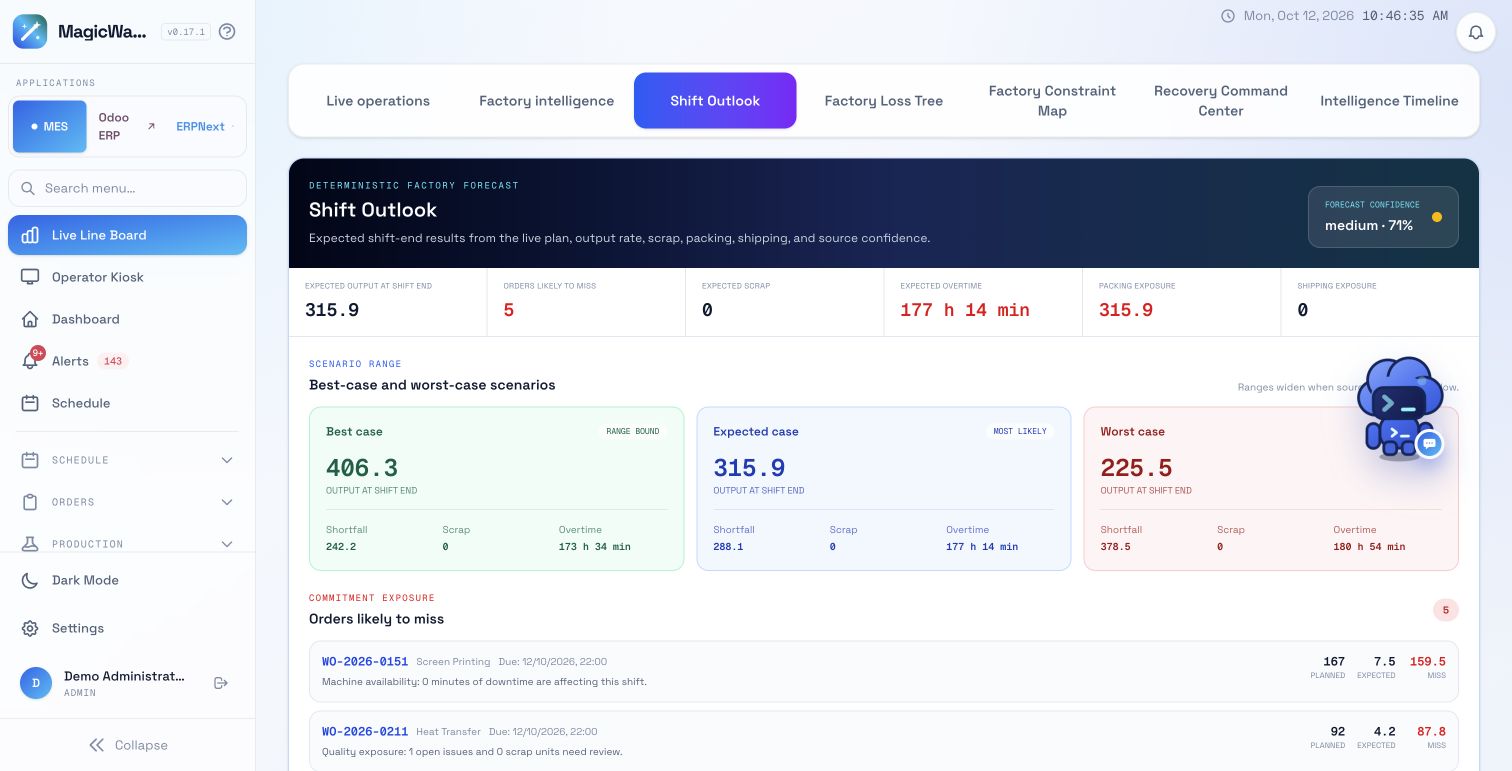
See what the shift may miss. Review the next action.
Use the production outlook to start the right conversation before the shift ends. Follow the shortfall into its supporting evidence and review a response with your team.
Shift Outlook presents expected shift-end output, likely missed orders and scenario ranges alongside forecast confidence. It brings the live plan, production rate and recorded operational context into the outlook. The range helps teams review uncertainty around the expected result.
In a product walkthrough
Review the expected case together with the best and worst scenarios. Treat the outlook as decision context and validate the production data behind it.
02 / SHIFT FORECASTING
Trace the gap before choosing a response
The Factory Loss Tree distinguishes losses tied to recorded downtime and scrap from losses attributed to speed, scheduling, materials, workforce and reporting evidence. The Constraint Map adds shared dependencies and downstream exposure. Both views give the team a way to inspect the explanation for a shortfall.
In a product walkthrough
Follow the relevant loss and constraint evidence. Review observed facts and attributed explanations before settling on a production response.
03 / SHIFT FORECASTING
Compare options, then keep the human decision
The Recovery Command Center ranks interventions with evidence, estimated recoverable exposure, risk, timing and required approvers. Alternative impacts can overlap, so they are reviewed as options. Concrete proposals wait in the approval queue, and the Intelligence Timeline helps inspect the recorded sequence.
In a product walkthrough
Compare the options and check their prerequisites. Review a proposed change before approval, then inspect its recorded outcome in the appropriate product view.
PRACTICAL QUESTIONS
Before your product walkthrough.
Is this sales-demand forecasting?
Shift forecasting concerns the operational production outlook during a shift. The page focuses on expected output and possible production shortfalls.
Does forecast confidence guarantee accuracy?
Confidence and scenario ranges provide context for interpreting the outlook. The forecast is an estimate; assess source data and validation requirements for your factory.
Does a recommendation execute itself?
The governed factory intelligence workflow separates recommendations, concrete proposals and execution. Proposed changes require a human decision before they are applied.